
The Toughest Choice: What vs. How
The ambitious construction of a crucial road up a treacherously steep hill had reached a standstill. The supervisor, burdened by the immense pressure of his deadlines, faced a crippling challenge: identifying the shortest, most structurally sound route capable of withstanding unpredictable weather. Knowing that geological stability varies wildly across rugged terrain, he exhaustively consulted maps and charts, but the optimal path remained elusive. He was professionally at his wit's end.
Amidst his frantic efforts, a donkey herder—a man the supervisor initially dismissed due to his humble appearance—stopped to inquire. When the stressed supervisor reluctantly shared his dilemma, the herder simply declared, "That is a very easy problem to solve."
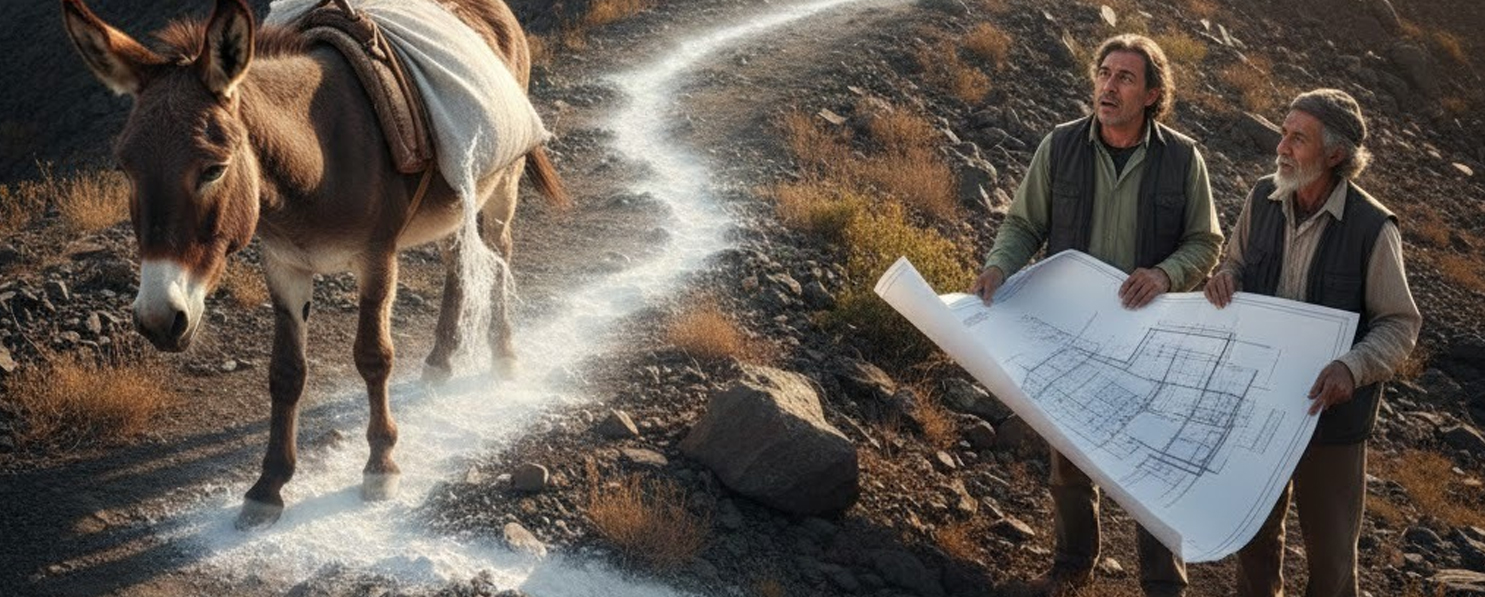
Challenged to prove his astonishing claim, the herder took immediate, decisive action. He placed a sack of lime (with a small tear) on a donkey's back and guided the animal toward the peak. The sure-footed donkey, in minutes, ascended the slope, leaving a distinct, bright lime trail in its wake.
Build your road by following that trail," the herder instructed.
He then offered the core of his wisdom: "Donkeys are instinctively clever. They never step on fragile ground and always choose the most direct, stable route to their destination. The trail they leave is the perfect, safe foundation for your road."
Humbled and amazed, the supervisor recognized the brilliance in this simple, unconventional solution.
The Leadership Ascent: Leader vs. Manager
The supervisor's predicament mirrors one of the toughest choices in leadership: the challenge is rarely what to achieve, but how to get there. Many professionals know their goal but struggle to define the path.
The true differentiator between an Owner (Manager) and a Leader lies in their relationship with their team:
| Manager/Owner Mentality | Leader Mentality |
|---|---|
| Primarily concerned with productivity, profitability, and materialistic growth. | Develops a sense of ownership, mutual trust, and equitable growth among all teammates. |
| Leans on the old school of management (Chain of Command, Authoritative Decisions, rigid hierarchy). | Simplifies processes, evokes the spirit of togetherness, and relies on the competency of the team. |
The managerial hierarchy, often built on command and control, makes processes complex. A real leader, like the donkey herder, simplifies the complex, trusts the innate wisdom (competency) of others, and finds the shortest, most effective route to the summit.
Companies like TATA—a name synonymous with T4T (Tata for Trust)—did not build their legacy by strictly adhering to managerial hierarchy, but through genuine, trust-based leadership. The trust and legacy they share are virtually impossible to replicate.
The real magic happens when a leader becomes your manager. This tale teaches an invaluable lesson: Be the leader—the trusted pathfinder—not merely the manager of tasks.